

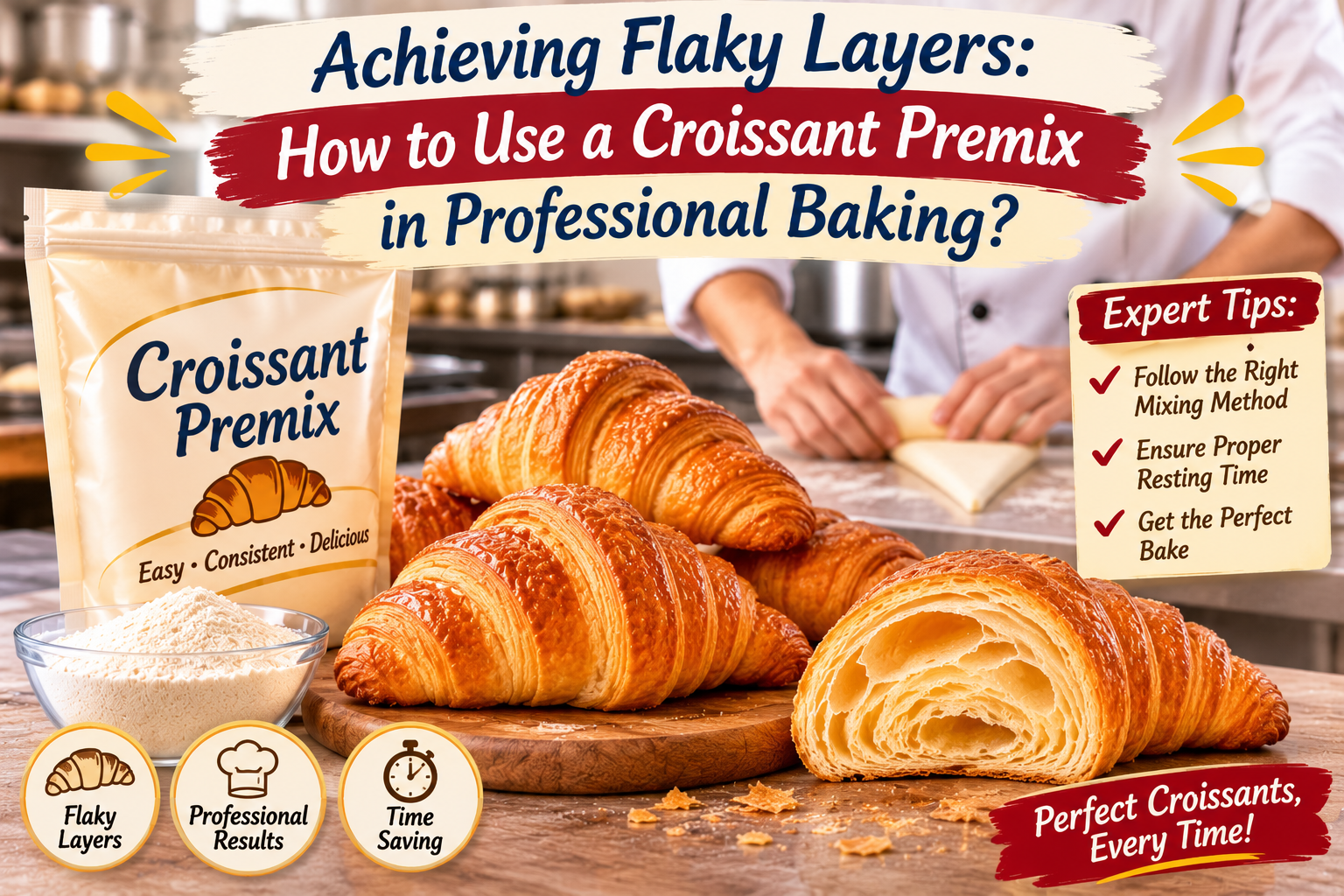
Ideal for bakeries, patisseries, cafés and hotel breakfast buffets; butter croissants have become one of the major products for pastry chefs today. Customers who buy butter croissants are looking for the softness, flakiness and flavour of good butter croissants. For pastry chefs, bakery & foodservice professionals, making the same butter croissants in identical shape, size & quality requires much more than expertskills in lamination. Using reliable ingredients, standardized recipe and proper technologies is also vital for success.
Specialised croissant premixes and laminated pastry dough improvers are made for providing bakers with an easy-to-use tool for creating diverse laminated pastries, including croissants, Danishes, cruffins & more. It gives dough some kind of flexibility while it is being rolled out and folded and gives butter croissant a very pleasant taste.
What is a Croissant Premix?
A croissant premix is a kind of enzyme-based concentrate introduced for the baking of laminated dough products. A premix used in the production of French-style croissants and other laminated products, requires the use of 10% of the premix in the ratio of weight of flour, it needs to be used with refined wheat flour, chilled water, yeast and unsalted butter.
The ingredients used in this premix include milk solids, malted wheat flavor, malted barley flour, and vitamin C. All these ingredients act to enhance the dough’s elasticity, improve handling capability, ensuring layer separation during baking process and providing a better aroma for the butter.
This approach of using concentrated premix is preferred over complete premixes as bakers can decide the quality of flour. It can be used for the preparation of traditional butter croissants and similar laminated products.
The Rationale behind the Preference of Professional Bakers for Premix
It is paramount that a croissant has a consistent taste, texture and flavour in any commercial kitchen. When clients want a croissant, they expect it to match their taste, flaky layers and have the same buttery mouthfeel. The making of a croissant is a very demanding process, which requires precise temperature control, gluten processing and superb lamination skills. A simple error in terms of flour quality, the temperature of water or the consistency of butter can ruin the croissant.
A croissant premix is made in a way that ensures the better quality of the dough and has a very high degree of elasticity. This makes it easier to cope with the rolling and folding process. It also ensures that the butter taste is preserved.
The mixing itself does not take much time. Generally, croissant dough is being mixed for 4 minutes at slow speed and then another 2 on high. It is important to reach a dough temperature of 16-18 °C for better lamination. This is a method suitable for bakeries, pastry shops and hotels where many croissants are baked at once
How Concentrate Impacts Butter Croissant Production
The type of concentrate chosen affects production process in several ways:
- Dough handling: With improved elasticity and tolerance, the dough becomes more manageable. Laminated dough is easier to stretch and fold with minimal ripping or butter leakage.
- Layering and oven fuel: Functional ingredients and enzymes help with dough layer separation and butter layer separation thereby giving good volume and great flakiness.
- Flavor and texture: Any malted components and milk solids increase butter aroma and flavor and help with crumb structure.
- Consistency and output: Uniform formulation makes process control easier. Yield relies on scale accuracy, folding number, proofing conditions, and baking specifications.
A regular production process consists of preparing dough and resting or chilling it, wrapping butter block (usually 50% of flour weight), and performing multiple folding operations (two double folds, some single folds, or three single folds). Laminated dough is chilled, cut, and shaped and then allowed to rest and proof (for 30 to 40 minutes at 28 °C and certain humidity level)
Practical Recipe Approach for Butter Croissants
An effective butter croissant formula using the premix might include 100 g Croissant concentrate, 900 g refined wheat flour, 380g to 520 g chilled water (adjusted according to specific recipe needs), yeast, a small amount of additional butter and sugar if desired, and 500 g of unsalted dry butter for lamination. Some variations incorporate a whole egg for richness. The method emphasises keeping both dough and butter cool throughout lamination to preserve distinct layers.
Gentle rolling on a chilled surface, adequate resting between folds, and careful shaping help maintain the laminated structure. Proper final proofing allows the dough to expand without collapsing the layers, while correct baking temperature and time produce the characteristic golden colour and crisp exterior.
Tips for Effectively Selecting and Using a Croissant Mix
Beginning with determining the goals of the production process:
- Menu considerations—The classic butter croissant and some other similar pastries can make the most of a specially designed croissant mix, but the mix can also be used to make Danish or some other flaky European pastries if desired.
- Texture requirements—The baker is expected to achieve a light and flaky texture and a good volume of a product with a good butter taste. Choose the proper mix depending on the desired texture.
- Baking method — Make sure to consider the available mixing options and other baking equipment, working processes and available refrigerator space, etc.
The dough must be convenient for already existing workflow requirements. - Baking conditions—The oven type, accuracy of the temperature in it, as well as humidity levels will influence the quality of the end product. Make sure to try a new recipe on a small batch before using it on a larger scale.
- Butter quality and processing—Use butter of high fat content without any salt and proper flexibility.
Mistakes to Avoid
One comes across certain errors when dealing with croissant production. For example, when one believes every concentrate or flour blend acts in an identical way. Each product has its own characteristics that affect water absorption, extensibility and baking of the dough.
In addition, overmixing, letting the dough temperature rise too much and not waiting the recommended time before folding in the butter can jeopardize the integrity of the finished croissant. Finally, a baker cannot just depend on the product characteristics when trying to determine how the final product will behave during production.
Why Proper Selection is Important
For professional bakers, the use of a premix for croissants simplifies the preparation of first-rate croissants without depriving them of the desired flakiness, volume and flavor. It is a practical solution which gives one an opportunity to make laminated dough without any complications in day-to-day operations.
At the end of the day, however, the results one gets depend on what sort of product one wants to produce, prepare, and where it will be done. If one understands the functional characteristics of a professional-grade croissant premix and applies this knowledge in practice, will surely get desirable output.
The Bottom Line
It is crucial to select appropriate equipment to prepare flaky pastries. A quality premix gives the best chance of making light and flaky croissants. If bakers are aware of the tools they are working with and have introduced these tools in day-to-day baking, they can be sure of continuous excellence in making savory pastries.